Showing posts with label Birdlife. Show all posts

Monday, 23 September 2013

Spectre-like wraiths of Northern Namibia


Damara Dik Dik - prehensile & poignantly beautiful
Northern Namibia's heat-stressed hills resonate an ancient energy and in the jagged fissures the furnace-like breeze recalls the ghost-like laughter of fallen friends & foe from the folly of a futile past. The echoes of The Border are long-since silent & all but forgotten.

The upside of the then South Africa-controlled South West Africa (Namibia since Independence in 1989) and the 'secret war' waged along its northern borders is a road-infrastructure that persists & which permits stress-free access to a rugged, desolate geography which, when coaxed, reveals a beauty unlike anywhere else on earth. In this heat-mirage lurks a fauna treasure-trove & a bird-list largely unique in the sub-region. Alisha & I ventured here for the latest leg of our 800-Challenge.
Ruppell's Parrot - not uncommon & a favourite


African Hawk-Eagle (L) - Ayre's Hawk-Eagle (R)
Two images merged  for interest & comparison

Time-allocation conflicts premised a condensed month-long excursion into two frenetic weeks. Our efforts would be confined to Namibia's northern areas only, excluding Etosha but inclusive of the Zambezi Region, formally known as the Caprivi or Caprivi Strip. 

The strategy was simple - we would devote each sunlit hour to the pursuit of the many endemics hidden among the rocks; on the thermals high above; on the plains below; on or under the flint-like scrub and on or in the gallery-'forests' along the many sand-locked waterways. Later we would glass the perennial Kunene & Kavango rivers for more... 

We were successful, on the whole, based on a generous dose of good fortune and Alisha's relentless determination. 

African Hobby - a breeding resident...??
Grey Kestrel - one of a handful of birds
Other than the distraction posed and the time spent pursuing two hitherto unconfirmed species more commonly found further north & outside the sub-region, we dipped on Augur Buzzard & Angolan Cave-Chat. Unless we return to the Kunene-region's Zebra Mountains, an unlikely eventuality, the localised Cave-Chat will remain forfeit for the 800 Challenge & is, perhaps, the first bird we've called time on before the year's expiration. 

The northern Namibian [Koakoland / Ovamboland] region also boasts a plethora of raptors & owls, from the more commonly seen Booted Eagle to the generally rare Grey Kestrel. Ayre's Hawk-Eagle & an unusually confiding African Hobby were seasonally-rare gifts and evidence of our good fortune.
African Barred Owlet - Kunene River Lodge
Of interest & an intriguing consequence of the region's geographical isolation is the prevalence of disjunct populations of species readily considered more common elsewhere. Whilst the north western race (ovamboensis) of White-browed Scrub Robin is not considered disjunct it illustrates, quite nicely, the many remarkable plumage variations regionally separated individuals of the same 'species' often develop over time. In the case of Orange River Francolin vocalisation is succinctly different too.
White-browed Scrub- Robin [ovamboensis]: Distinctly different
I usually avoid a 'then we went there & then we saw this' trip report believing that the birds are complimentary to the whole experience rather than the experience itself. Even so, on the birds themselves, on this particular trip, I'll offer the following two words:     MAG    NIFICENT!

A smorgasbord of delightful tits & bits from Bare-cheeked Babblers to Rufous-bellied Tits; & from Rockrunner to Short-toed Rock-Thrush. Yes we've seen them all before & notwithstanding the rather mundane yet commonplace 'once seen - once learned' attitude some birdmen suffer, even the most jaded traveler concedes a return visit to this trough..!

Rufous-bellied Tit
Black-faced Babbler
Bare-cheeked Babbler


Rockrunner
White-tailed Shrike
Short-toed Rock-Thrush
I could wax-on about shredded tyres in 40 degree heat; or confiscated meat (smoked & vacuum-packed...) at a disease-control barrier; or speeding fines I considered grossly unfair / illegal & specifically targeting foreign travelers; or interesting local custom - red-ochred bare-breasted innocents & some fancy head-gear; or diminutive San people; or bare-footed, bearded proprietors but I will limit, if not prefer, to tell two stories only.

Both stories involve unusual interaction between people & animals and sadly, as it turned out & at the time of writing, both ended tragically.

For comparative purposes only, intent & consequence were spectrum-opposites. In the first incident the animal was lost & in the second, two children were drowned.The intentions in the first were trite & perhaps the consequence of humanity at its best & worst. All things being equal you might be forgiven for concluding differently in the second incident. You may, in fact, decide otherwise..

In rural Africa we expect to apply urban logic whenever faced with a scenario we find unpalatable, intended or otherwise, even if only at first glance. It's grossly unfair & an injustice. People are measured by a standard against which they couldn't / shouldn't possibly comply. Take the procurement of meat for example. A vacuum-packed fillet steak had the same consequence for the donor at origin as awaits the hog-tied village beast.

Mtoti [African Clawless Otter] - Shamvura
Mark & Charlie Paxton from Shamvura Camp are, first & foremost, people with their hearts in the right place even if, at first glance, they appear a touch eccentric, by urban measurements. Goats, guineafowl, dogs, trees of remembrance & otters clamour at the feet & arms of both guests & owners for their daily fix of TLC all organic life seemingly demands. Whilst it makes for a memorable experience, the antics, in which the menagerie features strongly, are no less unusual than the bare-footed, big-toe-etched sand-scribbles of the Kunene Namibian lodge-proprietor further west; much further west..
Souza's Shrike
A short while ago locals 'found' another young African [Cape] Clawless Otter and as before (3x) the Paxtons accepted the now-orphaned otter for what I assume & I stress this point, was some reward. Mtoti, as she was dubbed, flourished on a diet of good intent & milky fish. Her canine companions accepted her into the owners' bed; guests accepted her in the pool and all was well. Her antics were enjoyed by all, none more so than by my own family.

It was with extreme sadness that we subsequently learnt of Mtoti's death. Our condolences to the Paxtons who considered her nothing short of kin. She lies buried, along with the other, mostly long-lived pets, under the remembrance tree overlooking the river from which she came. Without abrogating from the tragic events as they unfolded & as I write this, I can't help wondering why so many otter 'orphans' emanate from one small stretch of river.
Pygmy Goose - male
Returning to South Africa from Namibia via Botswana for Pel's Fishing Owl and some R&R behind a fly-rod for nembwe (bream) & tigerfish, we fell foul of rural Africa's timetable once again. This second incident will live-on in our memories for, I suspect, a very long time and for reasons less sure than I might have been before the incident.
Nile Crocodile
We were based at 'New' Drotsky's [Shakawe, Botswana] & by new I mean bloody awful.. The creaking, wooden monstrosity ['The Lodge'] & its accompanying wooden chalets, a long-iron away from the river & in scrubby bush, is a poor substitute for the charm of old Drotsky's, a putt away from the water's edge & in a natural, well-established garden dominated by towering trees.

Notwithstanding my irritated backward glare from the bow of the boat as the pre-fabricated lodge thankfully vanished over the papyrus-drenched horizon, this water has my ticket. Birds hum a deafening lullaby; crocs splash and tigerfish titillate. Following on from a morning session, interrupted by a cold lunch & a snooze, this particular afternoon started no differently. Reels screamed laughter & joy, teeth snapped & the bravely-fought were returned safely from whence they came. The Pel's Fishing Owl we had sought at first light stood stoically for the afternoon's shoot.

Meanwhile, no more than a short-cast upstream from where we played the drift, rural Africa demanded audience. Local people hastily gathered at the water's edge & although the rural African's audible reaction to an incident is usually muted, at best, we could tell from anxious faces that tragedy would accompany us home this afternoon. As we later learned the incident had transpired immediately behind us on the opposite bank.

A father & two children, as water-resident people usually do, had crossed the river in a wooden makoro [a canoe hewn from the trunk of a single tree eg: Sausage Tree] to collect reeds which they would later sell or use themselves in their home. Unbeknownst to the father & his boys they had inadvertently stumbled into the personal space of a hippopotamus bull which immediately attacked the boat & her occupants. The father made shore but the boat floundered & the two boys were lost, presumed drowned.

Our boat was later boarded, with permission, by the local police & we joined the army in a fruitless search late into the night. The boys & the bull had vanished as had the curious crowd from earlier in the afternoon. Friends & family stood silently in hope but dispersed immediately, almost trance-like, on confirmation of the worst. We're not unaccustomed to death in its many forms, far from it, but I remember returning home that night in reflective contemplation. Beneath our boat the river's flow had not diminished. Pods of hippo gathered in morbid murmur & watched us pass them by. The land was quiet but for the ordinary sounds of life.


PS: - I had video footage, post-incident, but it seems a little crass to keep. I haven't. In isolation we'd had a great day on the river. We had, in all likelihood, spent more in boat fees than that family might have earned in a year's toil. Much later that evening I carried that thought to bed.

As I write this two things come to mind. The first was from my boat skipper who in answer to my 'will they shoot the hippo..' shrugged & said: 'This is Africa. This is how it has always been & this is how it must be. We take from the river & the river takes from us..' The second was my late-night knee-jerk urban measurement of worth & associated misguided guilt. The boatman's wealth is the river, inclusive of its bounty & its dangers. If in fact the privilege to spend a few days on the water had cost me a resident boatman's annual toil, then by extrapolation & by my measurement, given that the boatmen spend the entire year afloat, are these people not more favoured than I could ever be? Isn't it strange that 'the world' doesn't see it that way...?

Next morning the makoros plied back & forth ferrying reeds, gathering nets - as they had done yesterday & if the world allows, they'll do tomorrow. Up above, low-flying military planes scoured the river in vain hope or perhaps just in performance of their daily duty. Hippos looked on & the birds thrilled the sunrise.


Thursday, 8 August 2013

Table Mountain's cute but Kruger steals the show!

Rush-hour traffic [Polokwane; Limpopo]
Brave the shake, rattle & roll [cable-way] or, in winter, the long, wet, windy, winding, walk to the top of Cape Town's Table Mountain & touch the bi-polar clouds racing here, then there; confused. Look towards the Atlantic, swivel left and enjoy man's ingenuity & architectural splendour. Space-challenged neighbours pass a cup of tea back & forth across the *payshio railing (*patio / balconette [a very small balcony or viewing deck]).. Rotate a touch to your right and behold Robben Island, the seat of South Africa's political past. A twitch further right - 'The Waterfront'. 90 degrees more & stare into the wind-induced, tear-filled eyes of the seething, red-jacketed multitude, well within your personal space, swiveling in synchronized unison, huddled, sheltered, cowered even - out of the wind... Cute!

Be adventurous; be daring; be bold & take the road less traveled, north; far north! Plant yourself at Kruger's Pafuri & swivel this way, that-way, any way. You decide. Nobody dictates your visual or auditory experience here. It's a smorgasbord of sensory delight. This is no hop-on, hop-off cliche. This is the Kruger National Park & this is Africa.

In the event that I 'fall off the boat' & my life-jacket springs a leak next pelagic off Cape Town's southerly point, let me say this; Pafuri isn't what it used to be, far from it. She's still in care. Early-season floods uprooted the local fauna & turned 'the camp' to mush & kindle.

Notwithstanding the natural calamity, there are very few spots in Kruger more wilderness-like than Wilderness' Pafuri Camp (ie: 'the camp'). Sadly the camp remains closed & more's the pity. Give me a pick & shovel; a two-night stay, once a year, for life & bob's your uncle, up she'll go! [To all my Wilderness friends..]

Crested Guineafowl - more numerous than ever before
By default then we were obliged to stay further afield, further south, at Punda Maria, a second cousin at best. A second cousin, that is, until you've walked the Flycatcher Trail, up the hill and behind the aging infrastructure.

Ignore the sewage pipe & look up. Swifts, spinetails, swallows, saw-wings, bat hawks, hawk-eagles, falcons, kestrels, eagles, buzzards, kites & vultures entertain; some perform the matinee, others the late, late-afternoon show.

Close your mouth & look down. Sunbirds, bulbuls, greenbuls, sparrowhawks, scrub-robins, robin-chats, nicators, flycatchers, hornbills, helmet-shrikes, shrikes, bush-shrikes, batisises, thrushes, starlings & guineafowls support the artists overhead. An after-dinner stroll to the hide which overlooks a natural pan presents buffalo, elephant, lion & leopard up close & personal. Hyena and jackal serenade the night. Enjoy repeat performances the next day & the day after & the day after that & the day after that that &...

Retz's Helmet-shrike [juv] - very cool
Retz's Helmet-shrike [ad] - also very cool
Arnot's Chat - [like me the male has the white-cap]


Since Punda Maria is such a hardship why were we there, again? Two reasons. First & foremost we wanted to revisit the Mahonie Loop or the S99 for the seriously uncool; a gravel track around the bend & back, behind the camp and a must for any aspiring birder. Secondly, we wanted Arnot's Chat & Dickinson's Kestrel for our 800 Challenge & our 700 Challenge respectively. Any birder worth their tuck speaks in tongues & on bended knee whenever the Mahonie Loop is up for discussion. Atypical habitat, high rainfall and a topographical mish-mash account for the very many specials this area has yielded in the past. Pennant-winged Nightjar perform at late-evening leks. Orange-winged Pytilia, Southern Hyliota, Racket-tailed Roller & White-breasted Cuckooshrike are also seasonally regular here & nowhere else.
Dickinson's Kestrel

Since we were out-of-season we concentrated our efforts up the road, rather than round the bend, for Arnot's Chat & the equally localised, if not more impressive, Dickinson's Kestrel.

Arnot's Chat is first heard, then seen. An unobtrusive tssssp breaks the reverie. Another tssssp a few yards left swivels the eyes, left... Tsssssp on the right jerks the attention right back right & seemingly emanates ghost-like from the very depths of the mature Mopani woodland. Drag your eyes away from the canopy, drop down to half-mast & if you've paid your dues, there he or she tsssps. Magical! Wonderful yes but not nearly as sublime as the little, wide-eyed, non-birding boy who after inquiring why we had stopped to look at trees beamed broadly at his Arnold's Chat. A birder born! Come down from your mountain & listen to the silence. Tomorrow is in good hands, thanks to Arnold's Chat.


Tuesday, 30 July 2013

SABAP2 - mapping the future!

South African Bird Atlas Project 2 - (SABAP2: Species search)
We're rather proud of our Citizen Science projects in this country. One of the more, dare I say it, relevant projects & I say relevant for selfish reasons only, is the South African Bird Atlas Project 2 or by its acronym - SABAP2; a joint venture between Birdlife South Africa, the South African National Biodiversity Institute (SANBI) and the Animal Demography Unit (ADU) at the University of Cape Town.

SABAP2 aims to map the distribution & abundance of birds in the sub-region & follows on from, as you might have guessed, the recently dubbed SABAP1; the region's first atlas project which concluded in 1991.

The field-data is collected by volunteers or Citizen Scientists who gather data, in their own time & at their own expense and within strict parameters. The unit of collection is the PENTAD, a square of roughly 9 kilometers per side or 5 minutes each of latitude & longitude. Species recorded within the PENTAD are collated & submitted to the database. To date some 90000 of these checklists have been submitted by volunteers; something to crow about, no doubt..

I must admit we've been somewhat lax ourselves on submissions to SABAP2 for no particular reason other than complacency. Off the point & for what it's worth & in our defence, Alisha & I contribute more regularly to The South African Bird Ringing Unit or SAFRING, a bird-ringing (banding) project for qualified / trained banders (ringers) who collect & submit biometric (morphological) data to a database. We intend to be more diligent in our submissions to both projects & others, although almost certainly only after the conclusion of our 800 Challenge given current time constraints.
Greylingstad - A Rock Pipit's view
Bird feeders & nectar bottles = a 'bird-friendly' neighbourhood.


As we progress it becomes more difficult to add new species to our Challenge list, particularly during the periods when obligation keeps us at home. It's during these quiet periods & whenever possible, that we steal away for a few hours & attempt a 'mop-up' of the species we've yet to record.

One such species we hadn't recorded, until now, was the African Rock Pipit. Although we'd seen this pipit in years past, relatively close to home, we thought we'd stack the deck, improve our chances of success & sneak a peak at the SABAP2 database.

One of the PENTADS which records the African Rock Pipit fairly regularly (11.11% of cards / checklists submitted) is 2640_2845; a 9x9 square of hillside & grassland off the R23, behind Greylingstad, in South Africa's Mpumalanga province. Although a good hour's drive from home & a little further afield than some of the other PENTADS, which also recorded the bird, we thought we'd go where neither of us had been before... & why not? To pay for this service we'd atlas (record & submit a checklist) the PENTAD ourselves.
Interesting residents - Greylingstad's 'Mr Cool!'

Greylingstad is not, with respect to its many interesting residents, a town renown for its aesthetic appeal. This is beetle-brow country; folks are suspiciously tough & the dogs bite.. It was a surprise, therefore, to find a committed, bird-friendly resident who not only tends his / her garden in a manner conducive to attracting birds but who also tends the strip across the street with the same diligence & attention. Bird feeders hang in bunches.

For the record we submitted a winter checklist of well over 50 species, noted in a very short time; testament to the country's birding appeal & perhaps more so, the birding potential of the many off-beat & as yet unexplored parts of this country.

The pipit revealed itself not long after a short walk up the nearest text-book-like 'boulder-strewn hillside.' We enjoyed a successful morning aided & abetted, in no small measure, by the Citizen Scientists who had gone before & who, in giving of their time, had made our task less onerous than it might have been. It's also a tacit reminder to dig in pockets & give back whenever possible. Others may walk this way tomorrow.
Spring's a blossom around the corner

Orange River Francolin - one of the pentad's 2 Scleroptila francolin 


Wednesday, 13 March 2013

She's found her legs... Thank Flock!


Flock at Sea 2013

The sea calls to us and the draw is usually strong, for some more so than others. Gone are the days of wind, t'gallants, hornpipes & rum. Even so, we joined the return-ticket migration ex Cape Town to Namibia's Walvis Bay and we did so on the MSC Opera for some champagne and a la carte dining..

On the whole Birdlife's Flock at Sea 2013 was relatively successful whilst the MSC Opera was, generally, average.

I was disappointed by the, as it turned out, grossly inefficient embarkation & disembarkation procedures. A general free-for-all on the Friday, in the shadow of Cape Town's noon-day-gun, left both virgins (1st timers) & veterans ruffled & shuffled.

Here's what happened.

12pm - Opening bell.

Queue 1 - Luggage check-in. (ave. time -30 minutes.) The veterans avoided this palaver, dropped off their correctly- labelled luggage at 'baggage-handling' and joined queue 2. The virgins knew no better..

Queue 2 - Boarding allocation. (ave. time-1 hour.) Veterans & virgins both. No short-cuts, no clever tricks. SPF 30 required.

Queue 3 - Batch-allocation for processing. (ave. time-1 hour) Virgins perspired in the stuffy holding cell whilst Veterans sipped 'not for own-account' juice or water and patiently circled their choice of program off that night's activity schedule.

Queue 4 - Processing. (ave. time - 3 minutes.) ['Buon giorno.  Come sta?  -  'Smile please...']    Eh?      Flock off...!

Queue 5 - Deck 5 - Reception: Credit card / cash processing. (ave. time-1 hour) Smokers, nerves shattered, gathered in the smoking lounge, a novel idea for South Africans, to suck on some peace .. Non-smokers in this queue which stretched around this lounge & back to reception turned iridescently green on sea-smoke induced paranoia...

...and so it was, on & off, in Cape Town & Walvis.

Nota Bene -  'Psssst Capitano Pinto - we were all essere un po'di fuori (roughly: out of our minds) and we will chiudere il becco (roughly: to close one's beak..) when and only when you allocate prospective guests a STAGGERED time of embarkation prior arrival!

4 pm - All aboard; toot toot & off we went. Helicopters, world-records, binoculars and egos. Woohoo - Flock on!

6 pm - Hang on. Where's my luggage?

11 pm - Hold the boat! Where's my luggage...? By now I puzzare da fare schifo (roughly: stank to high heaven..)!      ps: if you're wondering about the Italian, the Opera is Italian -crewed & owned.

'Normal' people hung out here
Four more brief comments on the Opera if I may? 

Firstly, an observation of the cosmopolitan crew yielded some pertinent insights. If I had license to generalise, the vagaries in attitude between East & West was remarkable. I think I like Eastern service more than Western churlishness, especially at the table!

Secondly, the food was surprisingly iffy and that's being generous. How difficult can a cloche-covered egg & bacon be?

'Weirdos' hung out here
Thirdly, our Capitano had as much authority on his boat as I have in the kitchen. Yes I can make tea or even pop the bread in the toaster unaided, but I would surrender my financial affairs if I even glanced at the oven without authority.... His frantic calls to HQ for permission to change course or to unlock Deck 5, to allow photographic access, was an impotent lifting of the corporate veil which left little to admire!
Lastly, who can ever forget the evening entertainment especially the heart-shaped & pelican-sized floral headgear the boat's mincers donned on stage. I chuckle still...

Birdlife did well, very well. They also missed a trick or two.

Of the 2000 passengers on board only 1100 or so were Birdlife-affiliated. The remaining 900 'normal' passengers found our antics ...odd.

'Storm-Petrellll.... 'Where?? Bloody hell! ..Get out of the way. Damn you... RUN!!' - The abiding memory of 20+ birders frantically scrambling over a deck-chair on which reclined a bikini-clad 'normal' who, in fear, exited chair right & who then abandoned deck with some alactrity, will stay with me forever.

'
Beaks at Sea 
Wearing masks at sea to celebrate oneness with Birdlife at the Capitano's dinner was novel but would have been better if the entire ship's company had been apprised of the dress-code. Allocated seating made for slack-jawed silences at your table of strangers, none of them birders, clad as we were in our toucan-billed finest.. A cruel fate for the 'normals'! If Birdlife had presented a few logo-embedded masks to the 'normals' would that not have been two birds dead wif one stone..?

Early morning hopefuls
Home
The birding itself off the Opera wasn't great; it really wasn't, for two reasons.

Firstly ALL cruise boats sail close to shore if they can. If you liked cormorants, gannets & terns then you were in for treat. Pelagic birding as a result was poor to middling at best.

No question most of us were hoping for a pelagic rarity or two. Thus motivated, we kept vigil at the railings, watchful. Why then schedule lectures in the middle of the morning...?

The other observation is perhaps a little more controversial. Most of the guides were land-based experts and not sea-birders. Masks off to them for their efforts, preparation and enthusiasm but a moulting Subantarctic Skua can never become a South Polar whomever the hailer or the dollars spent at the pool-side bar.

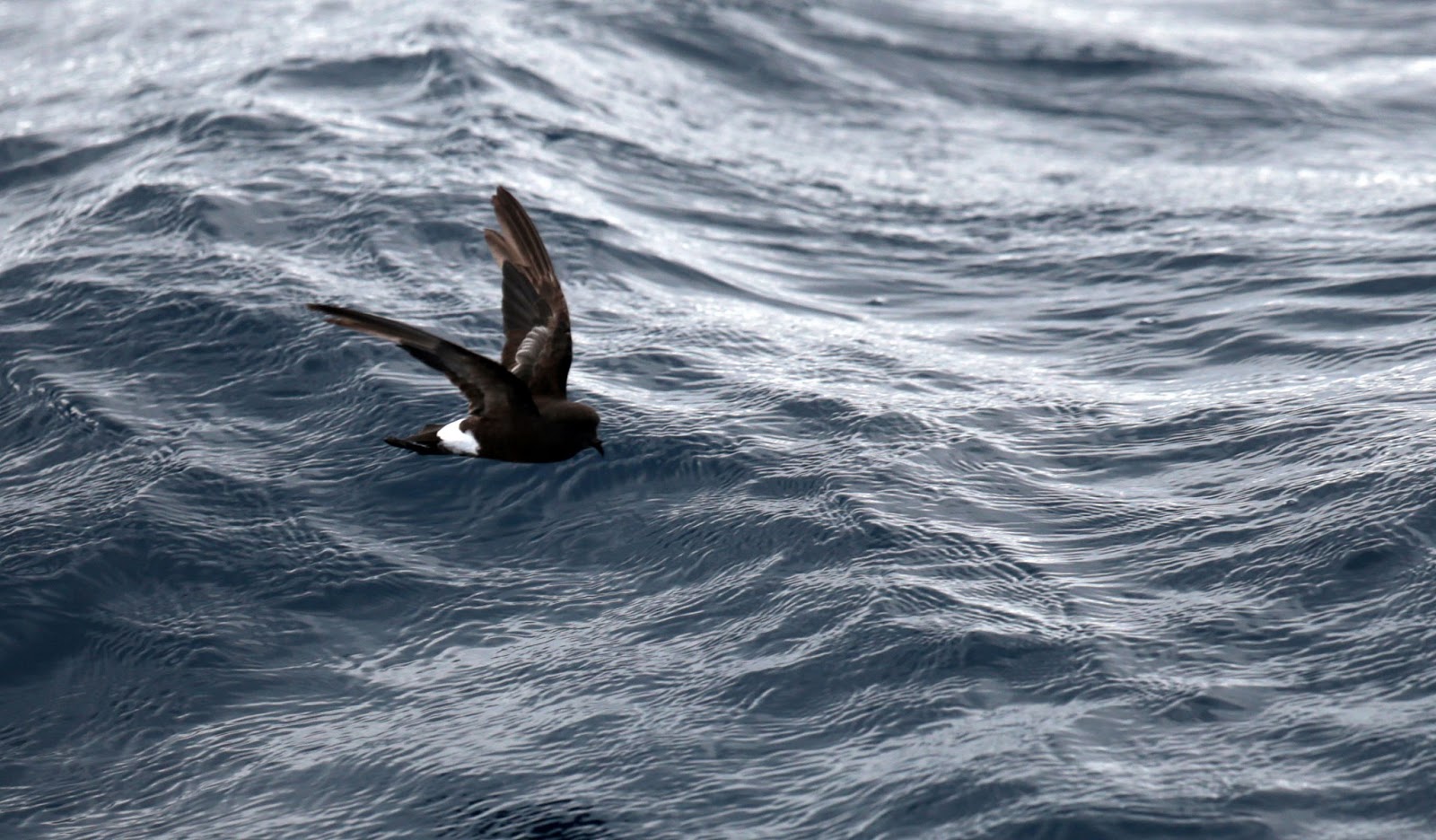
As for the pelagic birding itself, we recorded 4 Storm-Petrels, 3 Albatross, 3 Petrels, 4 Skuas, 2 Shearwaters and a specialist gull..; 3 of which were lifers! Birding on our first morning back to Cape Town was nullified by bad weather. I suspect we left behind one or two specials in fog-clad obscurity.

Alisha, my better half, is the very worst of sailors and suffers from chronic seasickness. She's always on the 'verge of death' each time she goes out to sea. This time however and for the very first time, Alisha suffered not at all; not once, not ever. Has Alisha found her sea-legs...?       Flock yeah!

Foggy-damp. Birdless or so it seemed
If we had to choose one spot to bird in Namibia it would have to be Walvis Bay & nearby Swakopmund. It's simply sublime.

A quirk of fate, some poor planning and a healthy dose of bad karma had us turn left instead of right which mean't we found our Avis rental 30 minutes late. As a result we dipped on the Swakopmund-based Elegant Tern which flew the roost no more than 2 minutes before we arrived on site... Days spent out to sea & we bombed by two (2) minutes!
Such is birding. The Buff-breasted Sandpiper, another lifer, was nevertheless a convincing consolation and so too the American Golden Plover, also a lifer.

As always we're grateful to the people who put us onto the rarities. Mark, Niall, Kevin & Allan et al for the BB Sand & Martin B. for the AGP. A special thank you to our good friends Louis and Ralda Heyns who joined us for the day and who kept the slavering hordes at bay until we returned to the sandpiper site from a scheduled lunch with friends in Swakopmund.

Since this is my blog and I'll gripe if I want to (with apologies to Ms. Gore) it would have been nice if the Pacific Golden Plover had been flagged for ALL to see.        Nice picture, Professor...!

Sadly the time permitted on-shore was too short to make a good fist of it. Still, any time spent in Namibia is better than a poke .. in the eye.

Buff-breasted Sandpiper
Cape Rock-jumper

We rounded off the trip with a few days in Cape Town itself. Fortunately we were called back to a very confiding Cape Rock-jumper, a bird we ourselves had missed and what a bird it turned out to be. Our thanks to Kevin, Niall & Callan et al. Who said birding's not a team sport?


So we dipped, dabbled, squawked, ticked and rolled with the tides. All in all a flocking good trip!


Monday, 25 February 2013

Pelagics - It's for the birds!

Atlantic Yellow-nosed Albatross
Anxiety & anticipation dominate our emotions, as always, the minute we board the Zest II; ex-Simon's Town en route the fishing grounds, some 25 miles SSW of Cape Point.

Alisha suffers from chronic seasickness; medicated, sedated or otherwise. Anticipating the dry-heaves is reason enough to make anyone anxious. I have no such qualms but I do, however, anxiously anticipate the day's catch...


To begin with, some formalities. A pelagos cruise operated by Zest for Birds on-board Captain Harry’s decommissioned ex-navy boat, the Zest II, is by far and away the best functioning outfit and for one simple reason only. Bigger is better and here we’re not talking egos either; we’re talking boats.

Atlantic Yellow-nosed Albatross
Foreign birders ie: anybody not from Cape Town who fly south for the sole purposes of a pelagic cruise will more often than not be met with disappointment on any other 'small-boat' outfit. On any given day the swells can be impressive! Perversely, the bigger the seas the more adverse the weather and the better the birding!

Not much younger nor more aesthetically appealing than the Zest II herself, with apologies to the boat, Messrs T. Hardaker, J. Graham, B. Rose, Cpt. Harry and 1st & only mate 'Chief', are constant fixtures on board. These gentlemen are to sea-birding what Shakespeare was to verbosity; simply world-class. Picking out Indian from Atlantic or Wilson's from European is, if anything, second-nature. Any pelagic adventure without this team is akin to a shark-cage in a sardine-can; a touch absurd...

Lest we get all zesty and before I accept their PR appointment, let me say this. The Zest II was not decommissioned because she blitzed across the seas.. Neither was she procured into life-long splendour and aggrandisement. She floats and that's all there is to say except perhaps to lament time lost getting to & from the pelagically-sweet-waters some 25 miles out to sea. You'll spend 7 hours just getting there & back.. Granted the likelihood for views of rare & interesting cetaceans en route are not to be scoffed at. That said and in fairness to the tub, if power is defined by the number of horses in the string, I suspect Cpt. Harry leaves most in the stable..

The formalities complete what about the birding itself? Two words; Bloody Brilliant! 

Long-tailed Jaegar (Skua)
19 species in total; 5 Shearwaters, 4 Skuas, 4 Albatross, 2 Storm Petrels, 3 Petrels & a specialist gull. Amazingly two were lifers; Long-tailed Jaegar and Manx Shearwater. Flesh-footed Shearwater was also a surprise, confined more usually, to waters further east. Bird numbers, as is always the case in summer, were low. The species count however, as is always the case in summer, was high!


Anybody who has been on a pelagos and who is, like me, a keen amateur photographer, will know the frustration a pelagic guarantees the shooter in post-production. I doff my hat to the more accomplished photographers on-board who secured the shots more consistently.

First off, store the gimbal & tri-pod at the hotel or take them along as a coat-hanger when the frustration has you hot under the collar. The vagaries of pitch & roll interspersed with the downwind air-speeds of those which shear across the water, makes composition akin to the accuracies usually associated with kindergarten's 'pin-the-tail-on-the donkey..' Shooting the birds floating on the water is about as photographically appealing as the Premier in her curlers. Where water joins sky light metering is a guess at best. Wholly brown or black birds require a stop or two up whilst the more prominently-white require a full stop or two down... Accurately metering the inconsistent light, adjusting the compensation, picking out the target from its peers of hundreds, adjusting composition for pitch, roll & airspeed, all in the 3 seconds or so the bird is in effective range, makes for imaginative cursing!

A gallery of Curses

Wingless - an albatrussed without Red Bull..
Circumcised at the wing - eligible for the para's.

1.5 nano-seconds too soon - too far / so near!
As appealing as Her Worship in Sunday slippers


Under-compensated - dark as the Dark Knight in a mood
Over-exposed - just one small stop... is enough!

Exit top right - Stage-fright?
Come back...! Please.
Swing through it son ...


By & large I had a cracker day. I can't say the same for Alisha who clung to the stern railing for the duration of the trip...

Back on dry land Alisha's first words were not entirely unexpected and in the interests of our younger readers I'll paraphrase - 'This trip is for the birds!' which coincidentally were my thoughts exactly. This trip is only for the birds and long may they skim the wave-tops. Total for the year to date - 522.